The National Society of the Daughters of the American Revolution (NSDAR or DAR) is a service organization open to any woman age 18 years and older who can prove lineal descent from an American Revolutionary War Patriot. Much of the work of DAR is accomplished by volunteers in its chapters across the United States and internationally in order to promote historic preservation, education, and patriotism.
Our Chapter
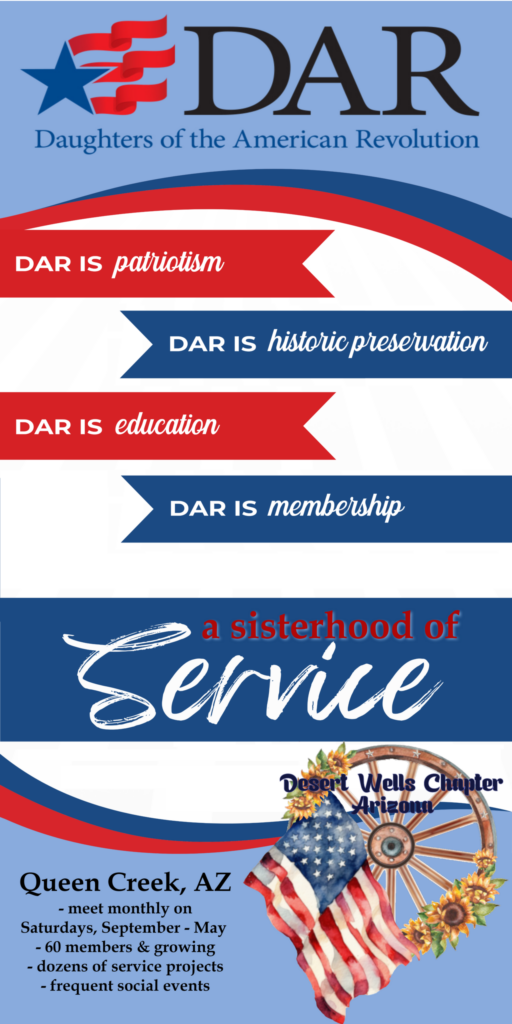
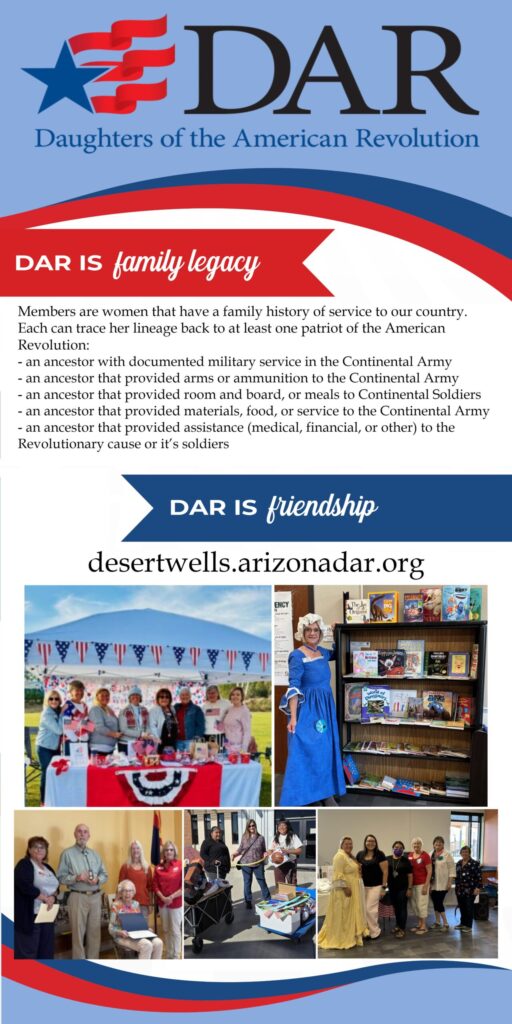
The Desert Wells Chapter, NSDAR, is a local chapter of DAR, based in Queen Creek, Arizona, but our members come from all over the East Valley. We are a very youthful, active and growing chapter, with monthly meetings (Saturdays, September through May in Gilbert, Arizona) and several social events every semester. Visitors and Prospective Members are always welcome! Contact us to learn more about joining DAR and the Desert Wells Chapter, NSDAR.
The Desert Wells Chapter, NSDAR, was organized in December 2005 with 15 members.
In keeping with the purpose of DAR, chapter members work together on numerous projects in order to promote historic preservation, education, and patriotism. We range in age from late teens to our 80s! We are professional women, students, stay-at-home moms, grandmothers, single parents, and both current and retired military members and wives. We will be here in casual attire and dresses. Some of us have multiple generations in DAR, while some of us are just starting as the first generation.
We invite you to contact our chapter Registrar to arrange for a meeting invitation or to get started in becoming a member of DAR, including tracing your heritage to find an American Revolutionary War Patriot.
Desert Wells Stage Stop
Our chapter is named after the old Desert Wells Stage Stop located on the former Andrade Ranch in Queen Creek, Arizona, now owned and maintained by the San Tan Historical Society. It was a small spur stop that held a significant role in Queen Creek’s history and folklore.
The stage stop was a resting area and water stop for horses used by the stage that came from Florence, continued through the gap in the San Tan Mountains, then on to Mesa.
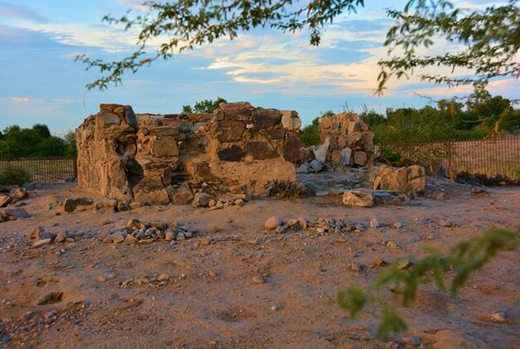
Desert Wells Stage Stop in Queen Creek, Arizona. Photo by Richard W Jenkins and used with permission.
The pioneers described the stop as a simple one-room building about ten feet square, constructed of rock, mud, and thatch. A trough for watering the horses ran around three sides of the building, while a porch graced the south side. It had one four-foot door on the south side and small gun ports instead of windows. A well was close by to fill the trough. This stage route was in use in the late 1800s and early 1900s.
Why Were Stagecoach Stops Significant?
Mail arrived in the Arizona Territory via stagecoach. Mail delivered by stagecoach was the main means of communication between the Arizona Territory and the rest of the country. Stagecoach travel through the Southwest was literally from watering hole to watering hole.
Travel was dangerous! Between 1875 and 1903, there were 129 stagecoach robberies in the Arizona Territory. Stagecoach mail delivery to Arizona ceased during the Civil War. Freight was shipped down the Colorado River at a great expense, but mail was only carried by travelers on horseback. Early settlers, mostly miners and ranchers, were completely cut off from the rest of the country. They had no idea what was happening with the war. Regular mail delivery was re-established in the 1870s and 1880s when the railroads came.
Even though the Desert Wells Stage Stop was a small spur stop, it holds a significant role in Queen Creek’s history and folklore.
The content contained herein does not necessarily represent the position of the NSDAR. Hyperlinks to other sites are not the responsibility of the NSDAR, the state organizations or individual DAR chapters.